
Few topics ignite as much fierce debate within the Grand Theft Auto community as vehicle handling. Ever since the massive physics overhaul between GTA IV and GTA V, fans have argued whether vehicle controls should prioritize punishing simulation or snappy arcade accessibility. With Grand Theft Auto VI, Rockstar Games and lead developers have engineered an entirely revamped automotive physics framework powered by the latest iteration of the RAGE engine (RAGE 9). If you are searching for how Rockstar GTA 6 driving physics feel, how they bridge the gap between GTA 4 and GTA 5, and how dynamic weather affects tire traction across Vice City, this comprehensive deep dive covers every mechanical nuance backed by developer insights and gameplay analysis.
GTA 4 vs. GTA 5 vs. GTA 6: The Evolution of Vehicle Handling
To understand the breakthrough handling model of GTA 6, it is essential to trace how Rockstar’s design philosophy evolved across past generations. Each title answered the challenge of open-world driving with fundamentally different priorities:
| Handling Feature | GTA IV (2008) | GTA V (2013) | GTA 6 (RAGE 9 Architecture) |
|---|---|---|---|
| Driving Philosophy | Heavy Simulation & High Inertia | Arcade, Snappy & Highly Forgiving | Dynamic Hybrid: Physical mass paired with responsive input |
| Suspension Body Roll | Extreme chassis pitching and boat-like leans | Virtually flat cornering with minimal roll | Class-Specific: Muscle cars pitch deeply; supercars remain rigid |
| Tire Grip & Braking | Loose traction; early braking mandatory | High grip; instant stops; mid-air pitch control | Surface-Aware: Tire friction patches deform realistically on asphalt, sand, and mud |
| Skill Ceiling | Very High (punishing cornering mistakes) | Low to Moderate (accessible to any casual player) | Mastery-Driven: Intuitive to drive, but rewarding drifting and weight transfer |
| Weather & Rain Impact | Slightly increased slide on wet cobblestone | Minor visual spray with modest traction reduction | True Hydroplaning: Standing rainwater puddles cause genuine hydroplaning physics |
As confirmed by Rockstar North studio leadership, GTA 6 avoids the extreme boat-like floatiness of GTA IV while eliminating the artificial “slot-car” on-rails feel of GTA V. The result is a refined hybrid where cars carry genuine weight, mass, and kinetic inertia, yet steer with razor-sharp precision during high-speed police chases.
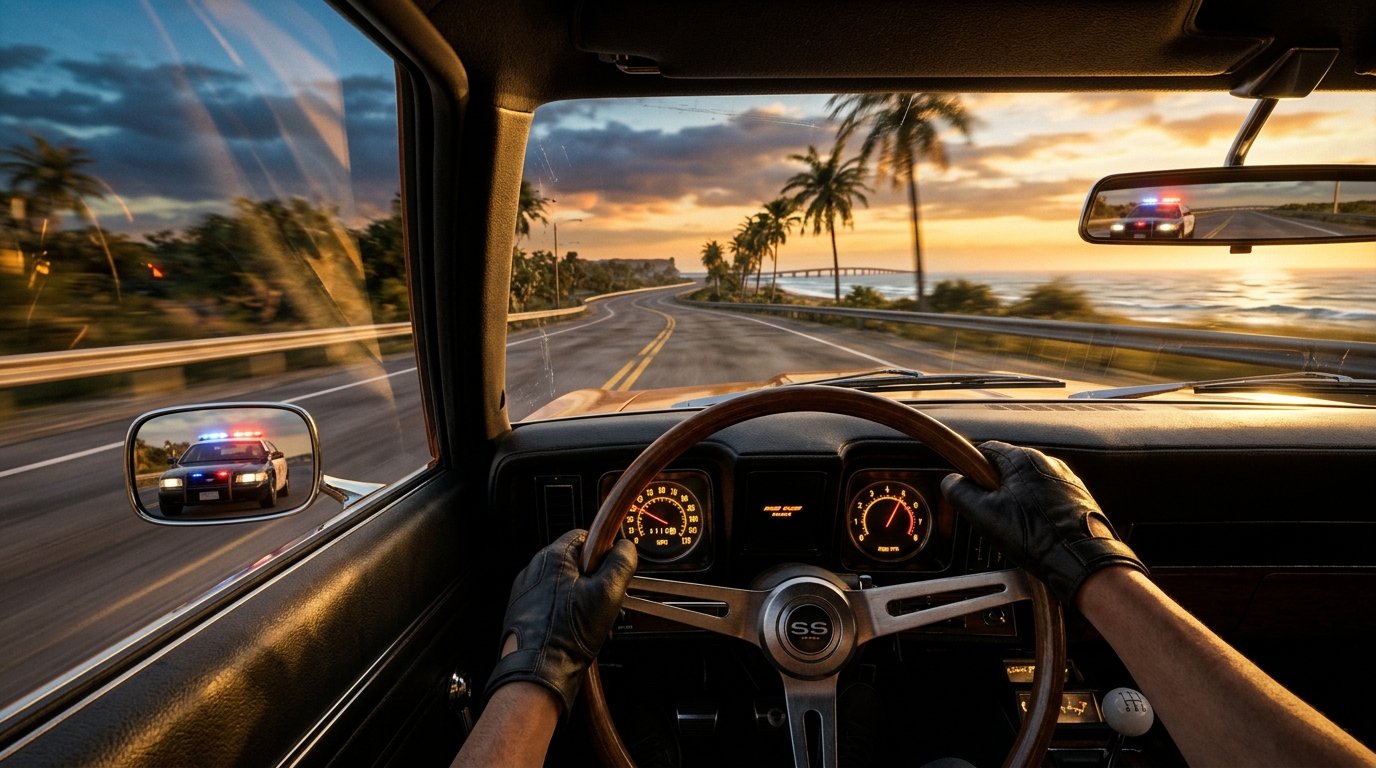
RAGE 9 Engine Physics: Weight Transfer & Tire Contact Patches
At the mechanical core of Rockstar GTA 6 driving physics is an advanced multi-point physics simulation calculated at high tick rates on current-gen console CPUs. The primary advancements include:
- Longitudinal & Lateral Weight Transfer: When slamming on the brakes, the front suspension coils compress, shifting weight over the front axle and lightening the rear. If you trail-brake into a sharp turn, the rear end gracefully steps out into a controllable oversteer drift rather than snapping into an uncontrollable spin.
- Granular Tire Friction Deformation: Tires are no longer treated as rigid single-point contact discs. The RAGE engine simulates flexible rubber sidewalls and tire contact patches. Under hard cornering, tire sidewalls visually deflect, generating authentic road scrub, squeal acoustics, and dynamic tire smoke.
- Drivetrain Mechanics (RWD, FWD, AWD): Rear-wheel drive muscle cars demand deliberate throttle modulation to avoid spinning out on launch, while all-wheel drive rally sports cars pull aggressively out of low-speed hairpins.
For players interested in visual and structural impact, this handling depth works hand-in-hand with our detailed analysis on GTA 6 car crash physics and soft-body deformation.
Weather Traction: Rain, Hydroplaning & Terrain Resistance
Vice City’s subtropical climate is characterized by violent afternoon downpours, coastal storm surges, and swampy backwaters. In Grand Theft Auto VI, weather is not merely a visual shader—it directly alters the friction coefficient of every road surface in Leonida:
- Wet Asphalt & Hydroplaning: When heavy tropical storms hit Ocean Drive, rainwater pools in street depressions. Hitting standing water at speeds above 65 MPH triggers genuine hydroplaning, lifting the front tires off the asphalt and temporarily eliminating steering authority until the car clears the puddle.
- Everglades & Grassrivers Mud: Off-road expeditions into the Grassrivers swamplands demand specialized off-road tires and lifted suspension. Heavy trucks sink into thick mud ruts, requiring low-gear 4WD engagement to avoid becoming hopelessly bogged down.
- Beach Sand Drifting: Loose coastal sand along Vice Beach provides low lateral resistance, allowing drivers to execute high-angle powerslides while spraying thick rooster tails of sand into the air.
To experience the full musical immersion while cruising through these weather fronts, browse the complete tracklists in our GTA 6 leaked radio stations lineup.
PS5 DualSense Haptic Feedback & Adaptive Trigger Integration
On PlayStation 5, Rockstar Games takes full advantage of the DualSense controller’s hardware features to deliver tactile road feedback directly to the player’s fingertips:
- Adaptive Throttle Resistance (R2): The right trigger stiffens to simulate the mechanical resistance of a real accelerator pedal. In high-horsepower sports cars, the trigger briefly “slips” or kicks back when tires break traction during wheelspin.
- ABS Brake Pulsing (L2): Slamming on the brakes on wet pavement triggers rapid, rhythmic vibrations in the left trigger, perfectly mirroring the pulsing of an Anti-lock Braking System pump.
- Haptic Road Textures: Through localized voice-coil actuators, players can physically feel the difference between gliding over smooth highway concrete, rumbling across wooden bridge planks, or rattling over gravel backroads.
To configure your analog stick sensitivity, deadzones, and steering curves for competitive driving, follow our guide on best controller and camera settings for GTA 6. Furthermore, enthusiasts aiming to dominate underground cruising culture should check our complete GTA 6 lowrider controls and hydraulics steuerung guide.
Vehicle Class Customization: Tuners, Muscle & Supercars
Unlike GTA V where vehicle handling felt largely standardized across multiple classes, GTA 6 gives every automotive category an unmistakable personality:
- Classic Muscle: Heavy cast-iron V8 engines produce massive straight-line torque, soft suspension that squats under hard acceleration, and pronounced chassis lean during high-speed turns.
- Exotic Supercars: Carbon-fiber construction, active aerodynamic spoilers that deploy under high speeds to increase downforce, and stiff anti-roll bars that keep the chassis glued flat to the road.
- Heavy Commercial & Armored Rigs: Long braking distances, high rotational inertia, and massive momentum capable of plowing through civilian traffic roadblocks without bleeding speed.
Summary: The Perfect Balance of Realism and Fun
The Rockstar GTA 6 driving physics represent a masterclass in game engine design. By uniting the tactile weight, realistic inertia, and technical suspension physics of GTA IV with the accessible fluidity, high speed, and cinematic stunt excitement of GTA V, Rockstar Games has delivered the definitive driving experience in open-world history. Whether you are drifting along neon-lit Vice City causeways or outmaneuvering highway patrol cruisers in a torrential thunderstorm, vehicle control in GTA 6 has never felt more visceral or rewarding.