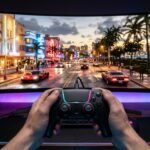
Ever since Rockstar Games unveiled the record-shattering first trailer for Grand Theft Auto VI, the gaming community has been locked in an intense technical debate around a single, pivotal question: will GTA 6 be 30 FPS on PlayStation 5 and Xbox Series X? As players have grown accustomed to 60 FPS Performance Modes in current-gen titles, the prospect of playing the most anticipated video game in history at 30 frames per second has sparked shock, skepticism, and heated debates across Reddit and social media.
To give you the direct, technical reality upfront: Yes, GTA 6 is almost certainly going to be locked to 30 FPS on base PlayStation 5, Xbox Series X, and Xbox Series S at launch. Industry-leading technical analysts at Digital Foundry, game engine programmers, and hardware specialists have scrutinized the initial footage and console hardware specifications, reaching an overwhelming consensus: achieving a stable 60 FPS on current console hardware is mathematically and architecturally impossible without fundamentally gutting the game’s core simulation.
Why is this the case, why can’t Rockstar simply “lower the resolution,” and what does this mean for the $700 PS5 Pro? Here is the complete, fact-checked engineering breakdown of why GTA 6 will be a 30 FPS title at launch and why that might actually be the best decision for the game.
The Real Culprit: The Console CPU Bottleneck
The most common misconception among casual gamers is that frame rate is dictated purely by the graphics card (GPU). Many assume that if a developer lowers the resolution from native 4K to 1440p or 1080p, the frame rate will automatically double from 30 FPS to 60 FPS. While that is true for GPU-bound games like corridor shooters and racing titles, it does not apply to an open-world sandbox of Grand Theft Auto’s unprecedented scale.
In an open-world simulation, the hard limiter is almost always the CPU (Central Processing Unit). Both the standard PlayStation 5 and the Xbox Series X are powered by an eight-core AMD Zen 2 CPU architecture dating back to 2019, clocked at approximately 3.5 GHz (PS5) and 3.6 to 3.8 GHz (Xbox Series X). While revolutionary in 2020, this processor must manage an astronomical workload in GTA 6:
- Dynamic AI & Daily Routines: Hundreds of individual pedestrians on screen, each running complex behavioral routines, emotional reactions, and social interactions simultaneously.
- Dense Traffic & Vehicle Physics: Real-time vehicle physics, suspension dynamics, tire friction, and collision geometry for dozens of cars streaming along highway corridors at high speeds.
- Acoustic Propagation & Sound Ray Tracing: Sound waves that dynamically bounce, echo, and occlude realistically depending on whether you are in an alleyway, a nightclub, or an open swamp.
- World Decompression & Asset Streaming: Uncompressing and loading ultra-dense urban data from the SSD in real-time as the player tears down Ocean Drive in a supercar.
As Digital Foundry’s Richard Leadbetter explained: “If a game’s CPU budget is fully consumed at 30 FPS calculating world logic, physics, and AI, reducing the rendering resolution does nothing to relieve the CPU. You hit a hard CPU ceiling where 60 FPS cannot be reached, no matter how low the GPU resolution drops.”

Digital Foundry’s Analysis: Ray Traced Global Illumination (RTGI)
Beyond the CPU bottleneck, Rockstar’s proprietary RAGE (Rockstar Advanced Game Engine) upgrade introduces visual technologies that demand immense computational throughput. Forensic analysis of Trailer 1 confirmed that GTA 6 relies heavily on hardware-accelerated Ray-Traced Global Illumination (RTGI) and Ray-Traced Reflections (RTR).
Notice the subtle lighting details in the trailer:
- Indirect Light Bouncing: Sunshine striking a bright yellow sports car naturally bounces warm yellow light onto the asphalt and adjacent concrete barriers.
- Natural Interior Shadowing: Stepping into a convenience store or pawn shop shows deep, physically accurate ambient shadowing rather than artificial, glowing screen-space ambient occlusion (SSAO).
- Volumetric Atmospheric Scattering: Vice City’s humid neon night air diffuses headlights and billboard neon organically across mist, rain puddles, and water surfaces.
Calculating real-time ray tracing calculations on AMD’s RDNA 2 GPU architecture is notoriously expensive. At 30 FPS, the console has a generous 33.3 milliseconds per frame to execute these complex ray-tracing passes. At 60 FPS, that window collapses to a razor-thin 16.6 milliseconds. Attempting 60 FPS would force Rockstar to strip out real-time ray tracing entirely, fundamentally downgrading the game’s revolutionary lighting design.
Expected Frame Rates & Resolutions Across All Platforms
Based on current hardware benchmarks, developer leaks, and engine analysis, here is what players should realistically expect when GTA 6 launches:
| Platform | Target Resolution | Target Frame Rate | Upscaling Tech | Expected Performance Notes |
|---|---|---|---|---|
| PlayStation 5 (Base) | Dynamic 1440p – 4K | Locked 30 FPS | AMD FSR / Temporal AA | Rock-solid 33.3ms frame pacing; full RTGI; per-pixel cinematic motion blur. |
| Xbox Series X | Dynamic 1440p – 4K | Locked 30 FPS | AMD FSR / Temporal AA | Identical visual parity with base PS5; stable 30 FPS with minor resolution scaling during explosions. |
| Xbox Series S | Dynamic 1080p – 1440p | Target 30 FPS | AMD FSR | Lower internal resolution, reduced crowd density, and simplified ray reflections to fit within 10GB RAM. |
| PlayStation 5 Pro | Reconstructed 4K | 30 FPS / 40 FPS Balanced | Sony PSSR (AI Upscaling) | Crisper 4K image quality, enhanced ray-tracing reflections, and potential 40 FPS mode for 120Hz/VRR displays. |
| PC (Post-Launch) | Native 4K / Ultrawide | Unlocked (60 – 144+ FPS) | Nvidia DLSS 3.5 / Frame Gen | Requires high-end modern CPUs (Ryzen 7800X3D / Intel i7-14700K) and GPUs to achieve stable 60+ FPS. |
For in-depth analysis on how graphic modes compare, check our breakdown on GTA 6 graphics modes: 60 FPS performance vs 30 FPS fidelity.
Can the $700 PS5 Pro Run GTA 6 at 60 FPS?
When Sony announced the $700 PlayStation 5 Pro, many gamers assumed that its massive 45% GPU upgrade and PSSR (PlayStation Spectral Super Resolution) AI upscaler would finally make 60 FPS GTA 6 a reality. However, hardware engineers quickly pointed out a critical limitation: the PS5 Pro retains the exact same Zen 2 CPU architecture.
While the PS5 Pro includes a “High CPU Frequency Mode” that boosts clock speeds from 3.5 GHz to 3.85 GHz, that represents an increase of just 10%. To jump from 30 FPS to 60 FPS in a CPU-bound title, a game requires nearly a 100% increase in CPU throughput. A 10% clock boost simply cannot overcome that deficit.
However, the PS5 Pro can offer something transformative: a 40 FPS Balanced Mode. On modern 120Hz TVs with HDMI 2.1 and Variable Refresh Rate (VRR), 40 FPS sits precisely halfway between 30 FPS and 60 FPS in terms of frame time (reducing latency from 33.3ms down to 25.0ms). This provides dramatically smoother camera panning and responsive driving controls without overloading the CPU. Read our complete PS5 Pro vs Base PS5 GTA 6 comparison for full technical details.
Rockstar’s Historical Precedent: The 30 FPS Masterclass
Players anxious about a 30 FPS launch should remember one vital fact: Rockstar Games has never launched a mainline 3D open-world title at 60 FPS on home consoles.
- Grand Theft Auto IV (2008): Launched on PS3 and Xbox 360 targeting 30 FPS (frequently dipping into the mid-20s during heavy rocket combat).
- Red Dead Redemption (2010): Locked 30 FPS on Xbox 360; celebrated as a technical benchmark.
- Grand Theft Auto V (2013): Pushed the aging PS3 and Xbox 360 to their absolute brink at a locked 30 FPS, delivering one of the highest-rated games of all time.
- Red Dead Redemption 2 (2018): Masterpiece world simulation locked at 30 FPS on PS4 and Xbox One. Even today, RDR2 remains one of the visually stunning games ever produced.
Rockstar’s philosophy has always been clear: Simulation depth, interactivity, and visual grandeur always take priority over raw frame count. They compensate for 30 FPS by mastering frame pacing (eliminating stutter), implementing per-object cinematic motion blur, and fine-tuning controller input latency. To calibrate your display for the best experience, consult our best TV and monitor settings guide for GTA 6.
Frequently Asked Questions (FAQ)
Will GTA 6 be 30 FPS on PS5?
Yes. Based on technical evaluations from Digital Foundry and game engine limits, Grand Theft Auto VI is almost certainly designed to run at a locked 30 FPS on the base PlayStation 5 at launch to preserve complex AI simulation and real-time ray-traced global illumination.
Can PS5 Pro run GTA 6 at 60 FPS?
It is highly unlikely. While the PS5 Pro has a significantly faster GPU and AI upscaling, its CPU only receives a modest 10% clock boost. Because GTA 6 is heavily CPU-bound by crowd AI, traffic physics, and world streaming, a 10% boost is insufficient to reach a stable 60 FPS. However, the PS5 Pro will likely offer an exceptional 40 FPS Balanced Mode for 120Hz/VRR displays.
Why can’t Rockstar just lower the resolution to reach 60 FPS?
Lowering the screen resolution only reduces the workload on the GPU (graphics card). When a game’s frame rate is constrained by the CPU (which handles physics, vehicle handling, crowd logic, and memory streaming), lowering resolution does not increase frame rates. The CPU remains maxed out regardless of visual resolution.
When will GTA 6 be playable at 60 FPS?
Players seeking native 60 FPS or higher will have two primary avenues: the eventual PC version (expected 12 to 18 months after the console launch) running on modern high-end hardware, or an eventual next-generation remaster on future PlayStation 6 and next-gen Xbox hardware.
Will GTA 6 feel choppy at 30 FPS?
No. Rockstar Games is renowned for implementing flawless 33.3ms frame pacing, custom per-pixel motion blur, and optimized controller input polling. Similar to Red Dead Redemption 2 on PS4, GTA 6 will feel heavy, cinematic, and responsive despite the 30 FPS target.